


Countering climate change: Höganäs’ commitment to reforestation in Germany
Located in the Harz region, Höganäs’ site in Goslar has witnessed the critical situation in the area first-hand. Understanding its role in the community, Höganäs decided to team up with the State Forestry of Lower Saxony to help regrow this important ecosystem.
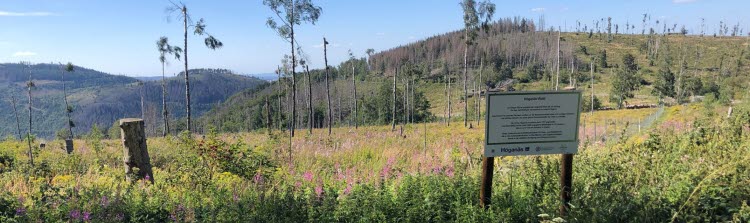
There is not much to see yet in a clearing called the “Höganäs Forest”, located just 5km south of Höganäs’ plant in Goslar. But in a few years, a lush oak forest will have emerged here. Höganäs’ collaboration with local State Forestry was first established at the end of 2022 with the first 2,000 trees being planted in early 2023. This year, Höganäs decided to contribute an additional 2,000 trees to further support reforestation.
"We have to be careful with the resources we use to ensure that we ourselves as well as future generations have a good place to live," says Tobias Beckmann, initiator of the forest partnership at Höganäs in Germany. "I am proud that Höganäs is putting this attitude into practice through local projects like this one."
Climate change and its impact on the forest
The forest ecosystem is vulnerable and has suffered greatly from the effects of climate change in recent years. Pest infestation, abetted by spruce monocultures resulting from mining and post-war reforestation, along with storms, droughts and, not least, the recent forest fires in the region, have caused devastating damage in the Harz mountains. Instead of scenic mountains and dense forests, bleak landscapes of open spaces and deadwood prevail.
Active help from the community is needed to save the forest
“This is not a small gesture; no, to us it’s a huge contribution Höganäs is making here. A great commitment that future generations will be able to benefit from,” says Josefine Barke from the Lower Saxony State Forestry. “The grounds on which the Höganäs Forest is located have a great deal of potential. As there are no existing trees, this area can be planted densely. New trees grow very closely to each other. That way, the young plants can stabilise each other and better withstand wind and weather, frost and snow. The good survival rate of the first trees planted here back in March 2023 has confirmed the favourable conditions in this area.”
It will take several decades before a healthy, climate-resilient forest is thriving; however, in five years' time, according to Josephine, a small grove with trees about 3 to 4 metres high should have grown at the site.
Background
|
||
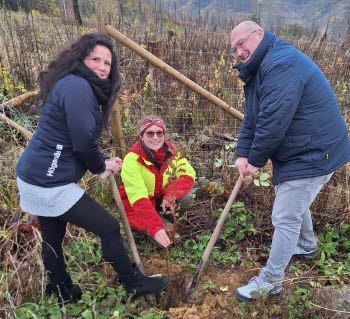
Equipped with spades, picks and sturdy shoes, Monika Maczurcak Ulrich Stranzenbach, and the team set off for the Höganäs Forest to plant the first batch of new oaklets. |
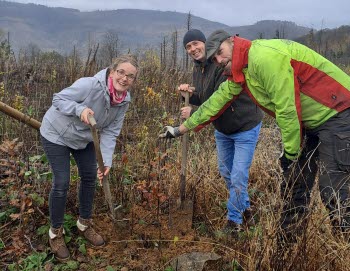
Sandra Marmulla and Tobias Beckmann planting trees. Not even adverse weather conditions could overshadow the high level of motivation within the team. |
Notícias e contatos com a mídia