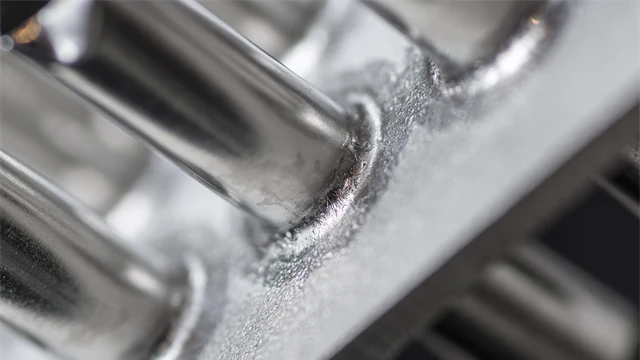


BrazeLet® F300S-8701
Höganäs’ unique and patented iron-chromium based stainless brazing alloy BrazeLet F300-20 offers excellent wetting properties and great corrosion resistance particularly developed for brazing of stainless steel materials in vacuum or protective atmospheres (dry hydrogen or argon). With excellent wetting properties, low brazing temperature and high corrosion and oxidation resistance it is a good choice for automotive and industrial heat exchangers. It is well suited for drinking water applications with strict requirements on metal ion leaching. Compared to nickel-based brazing alloys it offers a more attractive and stable cost. Compared to most of the standard nickel-based brazing alloys, BrazeLet F300-20 is able to fill larger gaps without brittle phase lines or cracks, which leads to a more reliable and safe brazing as well as more flexibility in part tolerances.
The solvent based brazing paste BrazeLet F300S-8701 can be used for spraying structured plates, typically found in flat heat exchanger designs. It ensures reliable coating over time without drying the spraying nozzles. BrazeLet F300S-8701 has no settlement, and no stirring is needed in the equipment. However, when opening a can from stock it is always recommended to stir the paste.
The sprayed parts can be dried with standard drying process (hot air) at 120 – 170 °C. The drying time depends on thermal mass, parts design and the used furnace and thus needs to be established. After drying, the paste has excellent adhesion to the metal sheet.
|
Nominal composition: Fe – 20Ni – 20Cr – 7P – 6.5Cu – 4Si Solvent type: Oil |
||
Download
Find out more

Contact us
Sales & technical support
Privacy policy
I agree that Höganäs can handle my personal data to contact me. My contact information may also be used in marketing purpose, such as newsletters and other relevant information. The data may be shared with our vendors. With my consent, I also confirm that I am over 16 year old.
More information about how we handle personal data can be found in our privacy policy.