

BrazeLet® Ni2DW-9007
The nickel-based brazing alloy BrazeLet BNi2 provides high strength when brazing stainless steel material in vacuum or protective atmospheres (hydrogen or argon). It provides excellent high temperature strength and oxidation resistance. Joint properties can be further improved by employing a diffusion hold after brazing. It is a versatile brazing filler metal used in aerospace, automotive and industrial applications such as heat exchangers and turbines.
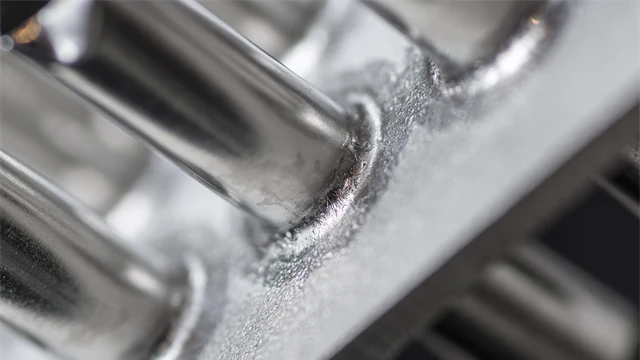
The water-based brazing paste BrazeLet Ni2DW-9007 can be used for dispensing applications, typically found on heat exchanger inlet and outlet tubes, housing to core joints and hole plates to tube joints. It dries quickly and sticks to all bevel and vertical positions without the need of pre-drying. It can be easily removed with water. The paste has a very low polymer content and the binder is specially designed to decompose cleanly at low temperatures, as to minimise need for furnace maintenance, while preventing pre-oxidation of brazing filler metal powder in marginal furnace atmospheres. It shows extremely good residue-free brazing results in both vacuum and continuous belt furnace brazing.
BrazeLet Ni2DW-9007 properties allow reliable application in a wide speed range as a result of the dispensing equipment / automatisation as well as the needle diameter. The paste can be delivered in cartridges for use in automated applications or different sized cans. It can be frozen and brought back to room temperature for use without any damage to its properties.
|
Nominal composition: Ni – 7Cr – 4.5Si – 3Fe – 3B Solvent type: Water
|
||
Download
Find out more

Contact us
Sales & technical support
Privacy policy
I agree that Höganäs can handle my personal data to contact me. My contact information may also be used in marketing purpose, such as newsletters and other relevant information. The data may be shared with our vendors. With my consent, I also confirm that I am over 16 year old.
More information about how we handle personal data can be found in our privacy policy.