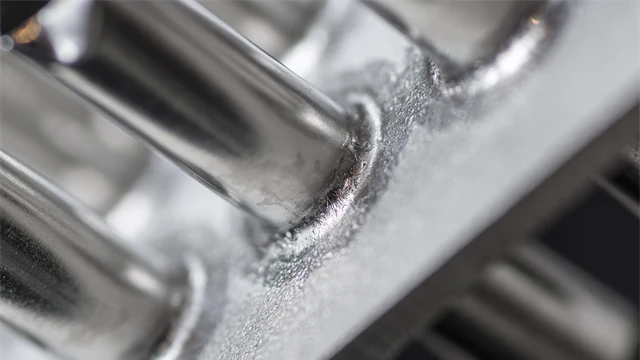


BrazeLet® SS316DW-8893
Höganäs BrazeLet SS316DW-8893 paste is developed for brazing of very big gaps (from 0.5 mm to around 3 mm). Traditionally, brazing filler materials are to be used for brazing gaps <0.1 mm. When not possible to design an optimum joint condition, this stainless paste for big gaps can be used. The 316L stainless powder particles divide one big original gap in hundreds of small gaps, giving back capillary force for brazing operation in vacuum or protective atmosphere. The austenitic 316L stainless steel powder has a superior hot gas and acid corrosion resistance, same as the base material typical in use.
BrazeLet SS316DW-8893 is suitable to be used together with any of the filler metals, e.g. Ni613. It is of great importance to apply the stainless paste exactly where it is needed as well as controlling the amount of paste applied. Furthermore, the stainless paste must be applied inside the gap area, filling out the complete space. During brazing, the 316L will stay where it has been applied. The application of brazing paste will proceed as usual from outside of the gap. The braze alloy will melt, infiltrate and fill the many micro gaps without brittle phase lines or cracks. Excessive application of BrazeLet SS316DW-8893 outside the joint area would remain visible after brazing as metallic elevations as the stainless 316L particles does not melt. As a practical approach, the required paste weight should be determined from the gap volume (cm3) and the BrazeLet SS316DW-8893 paste density (g/cm3). As a starting point, the same amount of brazing filler metal as BrazeLet SS316DW-8893 can be considered to completely fill the gap volume.
|
Nominal composition: Fe - 17Cr - 12Ni - 2.5Mo - 1.5Mn - 0.8Si |
||
Download
Find out more

Contact us
Sales & technical support
Privacy policy
I agree that Höganäs can handle my personal data to contact me. My contact information may also be used in marketing purpose, such as newsletters and other relevant information. The data may be shared with our vendors. With my consent, I also confirm that I am over 16 year old.
More information about how we handle personal data can be found in our privacy policy.