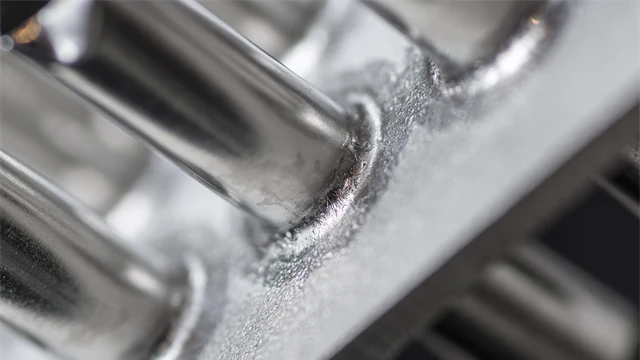


BrazeLet® Ni1AP-9003
The nickel-based brazing alloy BrazeLet BNi1A provides high strength joints with excellent oxidation resistance suitable for brazing stainless steels and nickel-based superalloys. It is suitable for brazing in vacuum or protective atmospheres (dry hydrogen or argon). The alloy is similar to BrazeLet BNi1, but has low carbon content. Joint properties can be further improved by employing a diffusion hold after brazing. The brazing alloy is typically used for joining parts subjected to high stresses and temperatures such as turbine components and diamond tools.
The brazing paste BrazeLet Ni1AP-9003 is typically in use for printing thin paste layers of about 0.05 – 0.2 mm on flat plates, on top of structured plates or fins by use of screens or stencils. A typical application is the printing on parts for flat heat exchangers. The use of rubber squeegees is recommended. Reliable printing requires a precise positioning fixture combined with the use of vacuum table or clamping device. Typical printing speed is 300 mm/s. Thin printing lines should have a width of >0.3 mm, small dots diameter should be >1 mm. The solvent based brazing paste BrazeLet Ni1AP-9003 increases productivity wherever drying of the paste is an issue. The paste has no settlement, and no stirring is required in the equipment. However, when opening a can from stock it is always recommended to stir the paste.
The printed parts can be dried with standard drying process (hot air) at 120 – 170 °C. The drying time varies depending on thermal mass, design of the parts and the used furnace and needs to be established.
|
Nominal composition: Ni – 14Cr – 4.5Si – 4.5Fe – 3.2B Solvent type: Oil |
||
Find out more

Contact us
Sales & technical support
Privacy policy
I agree that Höganäs can handle my personal data to contact me. My contact information may also be used in marketing purpose, such as newsletters and other relevant information. The data may be shared with our vendors. With my consent, I also confirm that I am over 16 year old.
More information about how we handle personal data can be found in our privacy policy.