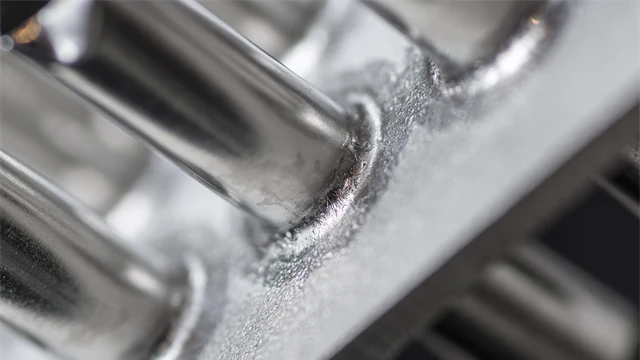


BrazeLet® Ni2R-9003
The nickel-based brazing alloy BrazeLet BNi2 provides high strength when brazing stainless steel material in vacuum or protective atmospheres (hydrogen or argon). It provides excellent high temperature strength and oxidation resistance. Joint properties can be further improved by employing a diffusion hold after brazing. It is a versatile brazing filler metal used in aerospace, automotive and industrial applications such as heat exchangers and turbines.
The brazing paste BrazeLet Ni2R-9003 can be used for roller coating fins or structured plates, typically found in flat heat exchanger designs. Depending on type of roller used the paste can be applied with thin layers either on top or on the side of the fin tips. Gap size between the paste roll and the scraper of 0.08 – 0.12 mm is recommended. The amount of paste is controlled by weight and is a function of the fins or structured plate design. BrazeLet Ni2R-9003 properties allow reliable application in a wide range of coating speeds, tested with good results from 3 m/min up to 20 m/min. The oil-based paste ensures reliable coating over time without drying on the roll. BrazeLet Ni2R-9003 has higher metal content and lower binder content compared to standard roller coating pastes, which decreases packaging and transportation needs for the same amount of brazing filler metal.
The coated fins can be dried with standard drying process (hot air) at 120 – 170 °C. The drying time depends on thermal mass, parts design and the used furnace and thus needs to be established. When dried, the paste has excellent adhesion to the metal sheet.
|
Nominal composition: Ni – 7Cr – 4.5Si – 3Fe – 3B Solvent type: Oil |
||
Find out more

Contact us
Sales & technical support
Privacy policy
I agree that Höganäs can handle my personal data to contact me. My contact information may also be used in marketing purpose, such as newsletters and other relevant information. The data may be shared with our vendors. With my consent, I also confirm that I am over 16 year old.
More information about how we handle personal data can be found in our privacy policy.